News ·
Starting the build
The non-negotiables we agreed before writing a line of code, the choices behind the station and the app, and the first jumper that found its way home on its own.
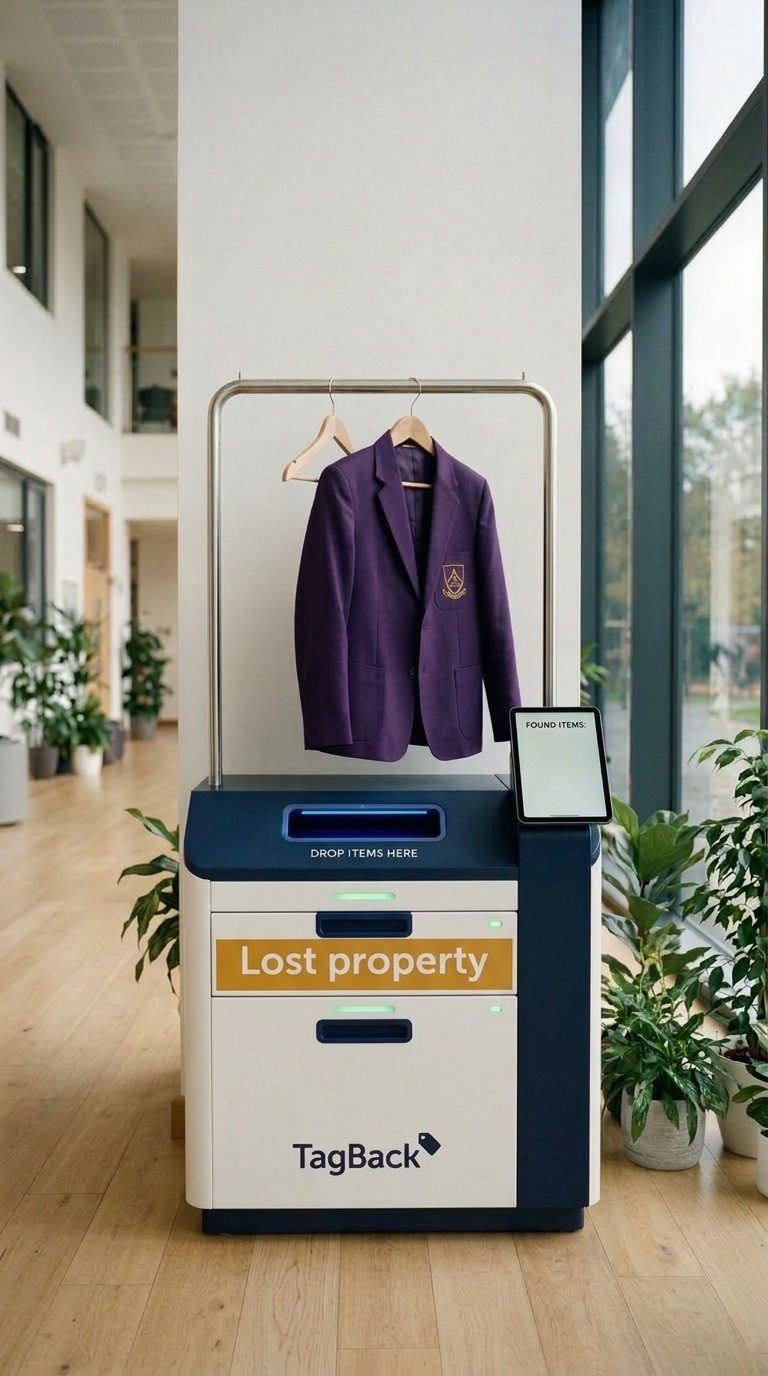
With the two of us agreed on the problem, it was time to answer the "how".
For months our conversations had been about what TagBack needed to do and why it mattered. Now the engineer and the head teacher had to turn a kitchen-table conversation into something a Year 3 parent and a school office could actually use.
Setting our non-negotiables
Before a single line of code was written, we agreed the fundamentals TagBack had to deliver from day one:
- It can't be used to track a child. No names on labels, no battery, no GPS. A label only means something to the school's station and the PIN-protected app. If we couldn't make that true, we wouldn't build it.
- No work for staff. Staff and pupils drop found items in. That's it. The station does the matching, the telling and the handing back. The school's part ends at the station.
- Free for the school, for good. The first station, installation, training and support cost the school nothing. Then the school earns a royalty on every label sale.
- Fair to every family. Labels had to be affordable, replaced free when they wear out, and discounted for families on benefits. Children from the poorest families gain the most when lost things come home, and we won't let price get in the way.
Early technical choices
This was the engineer's arena. The technology had to be as reliable as a school day, and invisible to the people using it.
We opted for:
- A passive label. A unique code and a QR code, nothing powered. Nothing to charge, nothing to fail, nothing that can be followed.
- A station that reads on its own. Drop an item through the slot or hang it on the rail and it's logged in seconds. No scanner in a staff member's hand.
- Outbound connection only, on the school's guest Wi-Fi, with no open ports and no personal data ever kept on the station. One 3-pin socket. No cabling, no IT ticket.
- A built-in backup battery, so the station keeps working through a power cut and reconnects on its own.
- Bank-grade hosting: encrypted, in the UK or EU, with a data processing agreement, a DPIA and privacy notices ready for the school's DPO.
From the beginning, every drop-in, notification and collection is timestamped and logged, so a school can always answer "where did it go?"
Mapping the journey
While the engineer worked on the station, the head mapped the journey from the school's side, and we walked through every scenario we could imagine:
- A parent ironing fifteen labels in on a Sunday night and pairing each one in the app.
- A Year 4 pupil finding a jumper on the field and dropping it in on the way past.
- A form tutor being told, automatically, which pupils have something waiting.
- A secondary pupil collecting her own PE kit with her own PIN.
- A teacher handing a coat straight back to a child, bypassing the station, and the parent still being told.
- A family moving school, and every tag moving with them in one tap.
- A DPO reading the paperwork before a governors' meeting.
We designed TagBack so each of these happens without friction, without a phone call to the office, and without anyone having to play detective.
Building around the people, not the process
- For parents, the focus was certainty: a message within a minute, and a PIN to collect with.
- For staff, the focus was absence: nothing to scan, nothing to sort, nothing to email.
- For children, the focus was privacy: no accounts, no names, no photos, no dates of birth, ever.
- For nurseries, the focus was the under-fives: chunky teddy bag tags with no small parts, and a compact station for the cloakroom. That became Teddy Tags.
The head kept us anchored in what a school can take on. If a feature needed a member of staff to remember something, it was redesigned until it didn't.
Our first milestone
The first real win was small and quiet. A labelled navy jumper went through the slot of the prototype station, and a few seconds later a phone on the kitchen table lit up: "Navy jumper handed in."
It wasn't finished. The drawers were wrong, the screen was too small and the message needed rewriting three times. But the loop closed, from label to station to parent, with nobody in the middle. That was the moment it stopped being a kitchen-table idea.
In the next post, we'll talk about Hitting some challenges: the questions parents and heads asked that we hadn't thought of, and how answering them made TagBack better.