News ·
Hitting some challenges
The questions parents, heads and safeguarding leads asked that we hadn't thought of, and how answering them properly made TagBack better.
No matter how clear your vision is, building something for schools means facing a reality: a school is a community first and a customer second.
Parents ask questions. Heads ask harder ones. Safeguarding leads ask the hardest of all. Every one of them improved TagBack. These are the challenges that shaped it.
Challenge 1: everyone wanted their name on the label
The first thing almost every parent asked for was a name on the label. It's what name tapes have always had, and a name feels like the obvious way to get something back.
We said no, and we had to earn the right to say it. A name on a label is readable by anyone who picks the jumper up, in school or out of it. A random code is readable by nobody. It only means something inside the app, paired to the parent's account, at that parent's school.
The answer wasn't to compromise. It was to make the code work better than a name ever did: a found item tells the family itself, within a minute, with no name needed.
Challenge 2: any phone can tap a tag
Our tags can be tapped by NFC with an ordinary phone. That raised an obvious question from a safeguarding lead: what does a stranger's phone see?
The answer had to be nothing. A tap from any phone only alerts the owner that the item has been found, and tells the finder to hand it in to the school. It never reveals who the child is, what school they attend, or who their parents are. Outside school, a scan simply says: hand it in.
Challenge 3: the wrong bag
Lost property isn't only the pile in the corridor. Half the class chat is about the coat that went home with somebody else.
So when another family finds a TagBack item in their bag, they tap it in the app and it opens an anonymous chat between the two families. Neither sees the other's details unless they choose to share them. They agree a hand-back that suits them: back to class, to the office, or between themselves. No "who's got ours?" in front of thirty parents.
Challenge 4: the teacher who just hands it back
Heads told us straight away: a good teacher who finds Olivia's jumper will hand it to Olivia. They will not walk it to a station. And they're right.
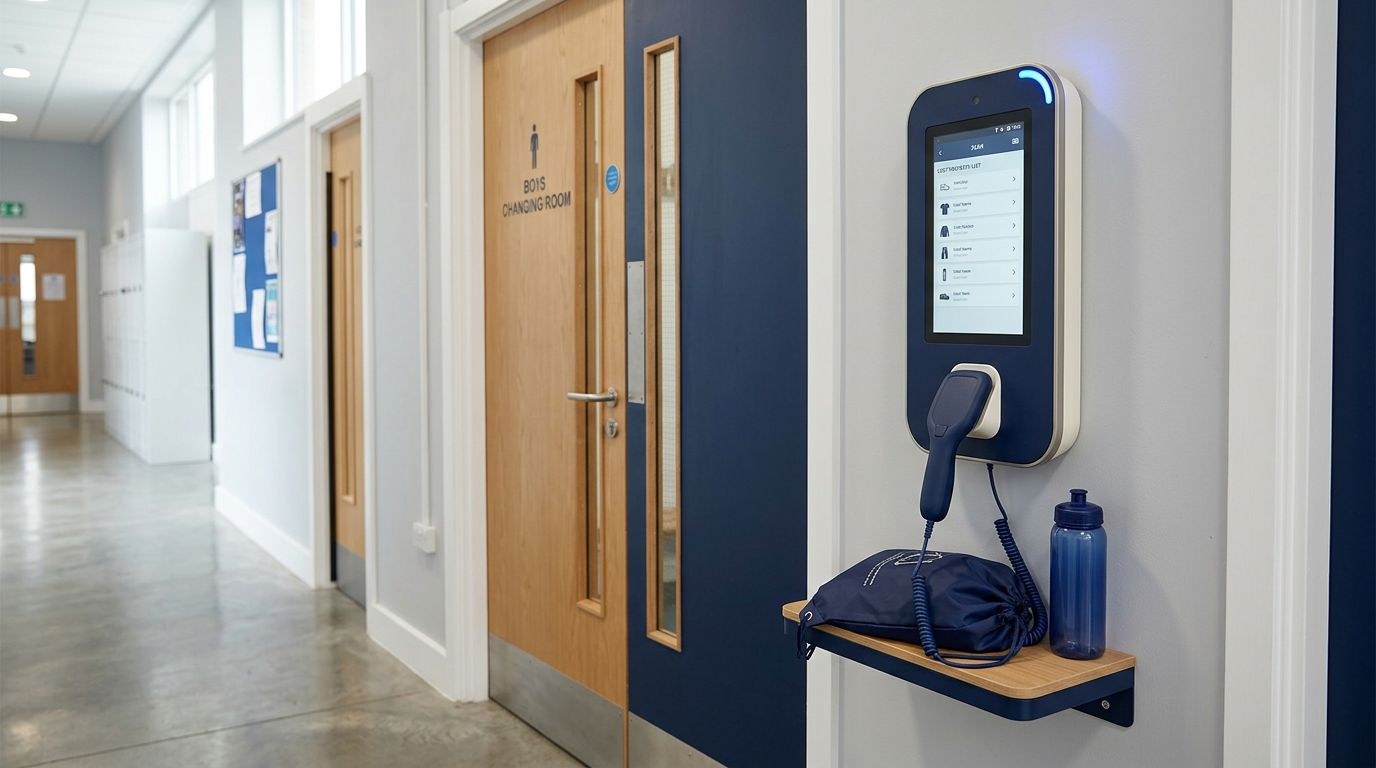
So the station isn't the only route. Staff can sign an item out with one code and a reason, "reunited with pupil", "passed to a parent", or a note, and the family is told what happened. And for PE changing rooms and busy doorways there's a wall reader with a wand: hold it to a found item and the screen shows which class it belongs to, so it goes back to the classroom before it ever reaches the pile. The child's name stays hidden until a member of staff keys in their staff PIN.
Challenge 5: secondary pupils aren't met at the gate
In a prep or primary school, a parent collects. In a secondary school, nobody wants a Year 10 queuing at the office with their mum.
So at secondary, pupils collect with their own PIN, with no account and no app. The parent is told in the app, can confirm in a tap, and every collection is still logged. The same system works for a four-year-old's comforter and a fifteen-year-old's PE kit.
Challenge 6: fair for state schools
An independent school can make TagBack labels part of its uniform policy. A state school has guidance on keeping uniform affordable, and heads were right to ask how this fits.
We built the answer into the model rather than the small print:
- Labels can be mandatory, or strongly expected on the uniform list. The first station is free either way.
- Family support takes 50% off labels for families on income-related benefits, bought through the school. The school's royalty can go towards it.
- Where more than 25% of pupils receive free school meals, we work with the school and the local council to supply labels at cost to us. That's our social value commitment, and it's not optional for us.
Challenge 7: it has to survive the wash, and the Wi-Fi
Two practical ones, both raised by parents.
A label that fades in the wash is the whole reason we're here, so ours are guaranteed for 500 washes and expected to last 1,000, and we replace worn or faulty ones free from a photo in the app.
And a station that goes dark when the school's power or network blips is worse than no station, so it carries a backup battery and reconnects on its own, using only an outbound connection on the guest Wi-Fi.
The lessons learned
These challenges taught us that getting a jumper home isn't about the headline feature. It's about the edge cases a school lives with every day: the kind teacher, the wrong bag, the teenager, the family who can't afford labels, the power cut.
- Some were about people.
- Some were about technology.
- Most were both.
They made the road longer. They also made TagBack something a head can put in front of a safeguarding lead, a DPO and a PTA without a caveat.
In the next post, The soft launch, we'll share how the first trials are structured: a handful of schools and nurseries, one half-term, volunteer families, and what we'll measure before anyone else goes live.