News ·
Choosing the team
The people building TagBack had to understand both sides of the school gate. Here is who we are, and why that combination matters.
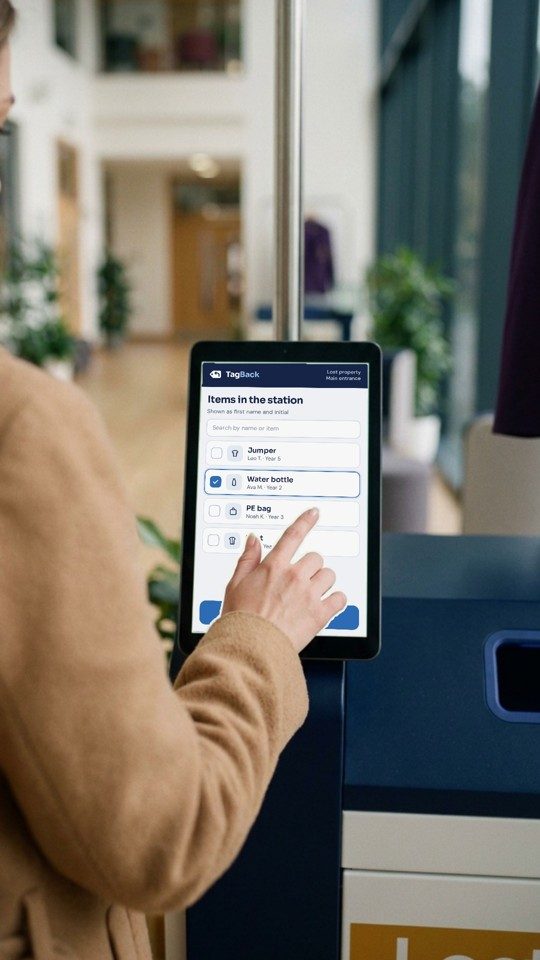
If the idea behind TagBack was born from lived experience, the team was built on the same principle: the people building the answer should have lived the problem.
We didn't start from a list of job titles. We started with the two people who had been describing the same missing jumper from opposite ends of the school run, and we added only what the problem needed.
The founder: the engineer who builds things that can't fail
One of us builds technology for a living, and not the kind that can afford a bad day.
His background is high street banking infrastructure, security-grade systems and software for global transport, where getting it wrong is never an option. He also runs a consultancy that multi-million-pound businesses call on to turn round struggling programmes of work and reshape how their teams deliver.
That shaped TagBack in two ways. First, the station, the app and everything behind them are built to the standards we use for banks: encrypted, auditable, hosted in the UK, with no personal data ever kept on the station itself. Second, we didn't start with a gadget and go looking for a use for it. We started with the problem, the people living with it (including us), and worked backwards.
He's also the parent in the class chat. The one who bought the same blazer twice.
The co-founder: the head teacher of 1,700 pupils
The other one of us has given twenty years to education and today leads a mainstream school of 1,700 pupils as its head teacher.
She sees the side parents never do: staff giving up their lunchtimes to sort coats nobody can match to a child, parents queuing at the office, and the end-of-term pile heading to the second-hand shop or the donation box.
More importantly, she knows what a school can take on, and what it can't. Every design decision in TagBack passed through one question first: does this make work for staff? If the answer was yes, it didn't go in. The school's part ends at the station because a head said so.
She also asks the questions every head asks before a safeguarding lead does: is it safe, is it fair, and will it survive an Ofsted week?
The first users: our own children
Before any school, our own children wore the labels.
That matters more than it sounds. It's why there are no names on the labels, why children never have accounts, why a phone that taps a tag in the street learns nothing, and why the app never asks for a date of birth or a photo. We built it with the care we'd want for our own, because they were first.
The installers: vetted, signed in, never alone
Every station is installed by someone with an enhanced DBS check, who signs in at reception and is never unsupervised with pupils. Installation takes one 3-pin socket and the guest Wi-Fi. No cabling, no IT ticket. The same team trains the school's staff and handles every station after that.
The partners: parents who are trusted at the gate
TagBack started in a parents' WhatsApp group, so parents are who we answer to. We're building a network of TagBack partners: parents and carers who are well thought of in their school community, who introduce TagBack to schools they already know and earn when a school goes live.
We only take on partners who are a good fit, and every partner has a call with us and a DBS check before representing TagBack. Families trust TagBack because parents built it, and we'd rather lose a sale than oversell it.
More than the sum of our parts
Individually, each part brings something essential:
- The founder's security-grade engineering and delivery
- The co-founder's twenty years in schools and a head's judgement
- Our children's uniform, as the first test
- Installers who meet a school's safeguarding bar
- Partners who are trusted at the gate
Together, we're united by one belief: if it's labelled, it should go home, and we can make that true without adding a minute's work for a teacher.
This isn't a project for us. It's a fix for something we've both lived with for years, and a refusal to accept "that's just lost property" as an answer.
In the next post, we'll take you behind the scenes of Starting the build: the non-negotiables we set before writing a line of code, the choices behind the station, and the first time a jumper found its way home on its own.